
- Rated 5.0 on Google
- 10 years’ experience
- 5-year workmanship guarantee
- Fully insured
- Free site visits
- No call-out charge
By Taylor Teasdale, Owner ·
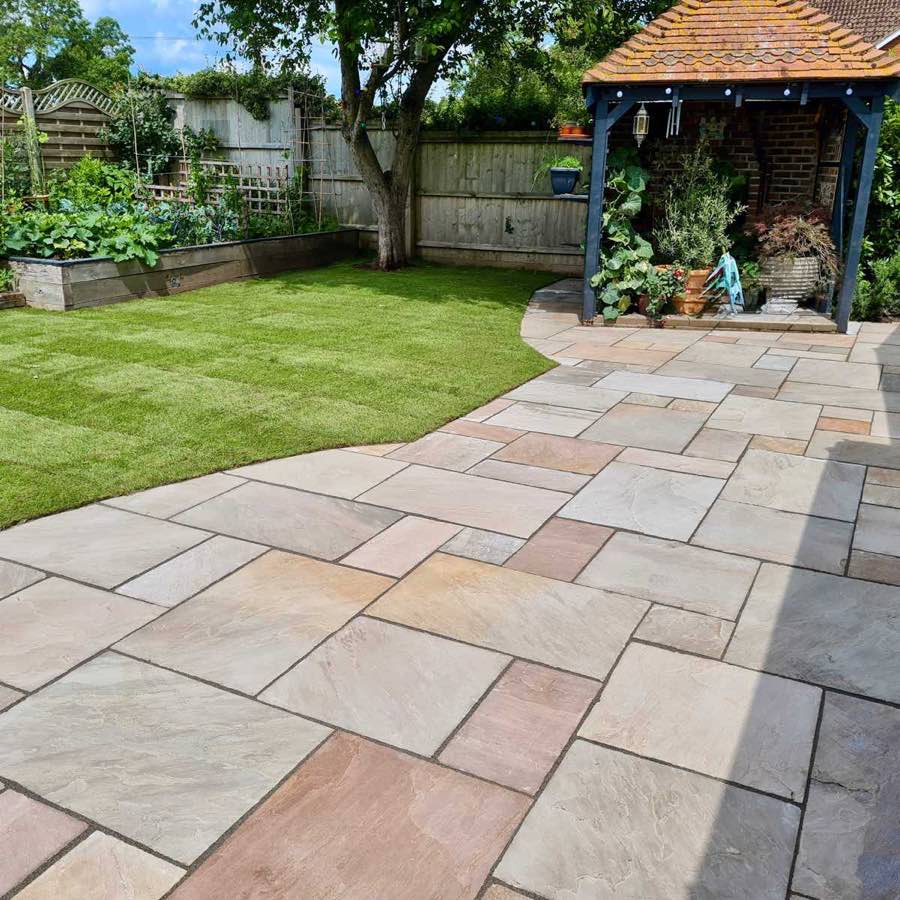
A patio is a smaller job than a driveway and the cost works the same way: the slabs are the visible part and a minority of the money. Most of it is what happens before they go down.
Rough costs per square metre
Supplied and laid, on proper groundwork, as a guide for 2026:
- Concrete paving — roughly £70 to £110 per square metre
- Indian sandstone — roughly £90 to £140 per square metre
- Porcelain — roughly £120 to £180 per square metre
- Natural stone, riven or sawn — £130 upwards, depending on the stone
A typical patio of 20 to 30 square metres therefore lands somewhere between £2,000 and £5,000 for most material choices. Anything far below that is worth asking about.
What you are actually paying for
Digging out and disposal. A patio needs excavating to take the build-up, and that spoil has to go somewhere. Tip charges are real money and should appear on the quote rather than arriving later.
The sub-base. Compacted hardcore, built up in layers. On soft ground or a former border it needs to be deeper. This is what stops the patio settling.
The mortar bed. The single biggest difference between a patio that lasts and one that does not. Every slab should be laid on a full bed of mortar supporting its whole underside. The shortcut — five dabs under each slab — is faster and leaves voids that fill with water and crack the slab in the first hard frost.
Falls and drainage. A patio must fall away from the house, and it has to finish at least 150mm below the damp-proof course. Getting this wrong is not a cosmetic problem, it is a damp problem.
Pointing. Either a traditional mortar point or a brush-in jointing compound. Both are fine done properly; the compound is more forgiving and more expensive.
What pushes the price up
- Access — everything barrowed through a side gate is slower than everything delivered to the back
- A sloping garden needing retaining walls or steps
- Building up levels, which means importing material as well as removing it
- Circles, curves and a lot of cutting
- Lighting, drainage channels or an outdoor tap
Sealing
Indian sandstone is porous and benefits from sealing, particularly against barbecue grease and red wine. Porcelain does not need it at all. Factor sealing in if you are choosing sandstone, and expect to redo it every few years.
Getting a comparable quote
Ask every quote to itemise the excavation, the sub-base, the bed, the slabs and the pointing separately. Two quotes with a thousand pounds between them usually differ on exactly one of those lines, and once you can see which, the decision makes itself.
Want a figure for your garden?
Free site visit, free written price, itemised so you can see exactly what you are paying for. No obligation either way.
Common questions
Patio cost questions
The slabs are, usually noticeably. But porcelain is dimensionally consistent, so it lays faster and with tighter joints, and it needs no sealing and almost no maintenance afterwards. Over ten years the gap narrows a long way. Indian sandstone is cheaper up front and has a warmer, more traditional look that suits an older house better.
Normally the bed. A patio should be laid on a full mortar bed, with the slab fully supported across its whole underside. The quick method is five dabs of mortar under each corner and the middle, which lays much faster and leaves voids. Those voids collect water, the water freezes, and the slab cracks or rocks. You cannot see the difference on the day it is finished.
Usually not. A patio at ground level in a rear garden is normally permitted development. It can change if the patio is raised significantly above ground level, if the property is listed, or if you are in a conservation area or National Park. Worth checking if yours is raised or the property is protected.
For a typical domestic patio, three to five days on site, depending on size, access and how much digging out is needed. Add time if there is retaining, steps, or the ground has to be built up. The mortar also needs to cure before heavy use, so do not plan to put furniture on it the same afternoon.
Ready to transform your driveway?
Free quotes, a 5-year workmanship guarantee, and a team that turns up when they say they will.