
- Rated 5.0 on Google
- 10 years’ experience
- 5-year workmanship guarantee
- Fully insured
- Free site visits
- No call-out charge
Why us
Why Cumbrian homeowners choose our patios
The base, done to depth
Dug out properly and compacted in layers. Nearly every rocking slab and standing puddle we get called to look at is a base that was rushed.
Falls set before we start
Water is walked away from the house and the finished level sits below the damp course. Get that wrong and you have moved a damp problem indoors.
Full mortar bed, every slab
Dot-and-dab leaves voids. Water gets in, freezes, and lifts the slab off the bed. It is the most common patio failure there is and it is entirely avoidable.
Honest about the material
We will tell you when sandstone is the better answer than porcelain, and when it is the other way round. We lay both, so we have no reason to steer you.
What it is
Garden Patios & Paving, built to last in Cumbria
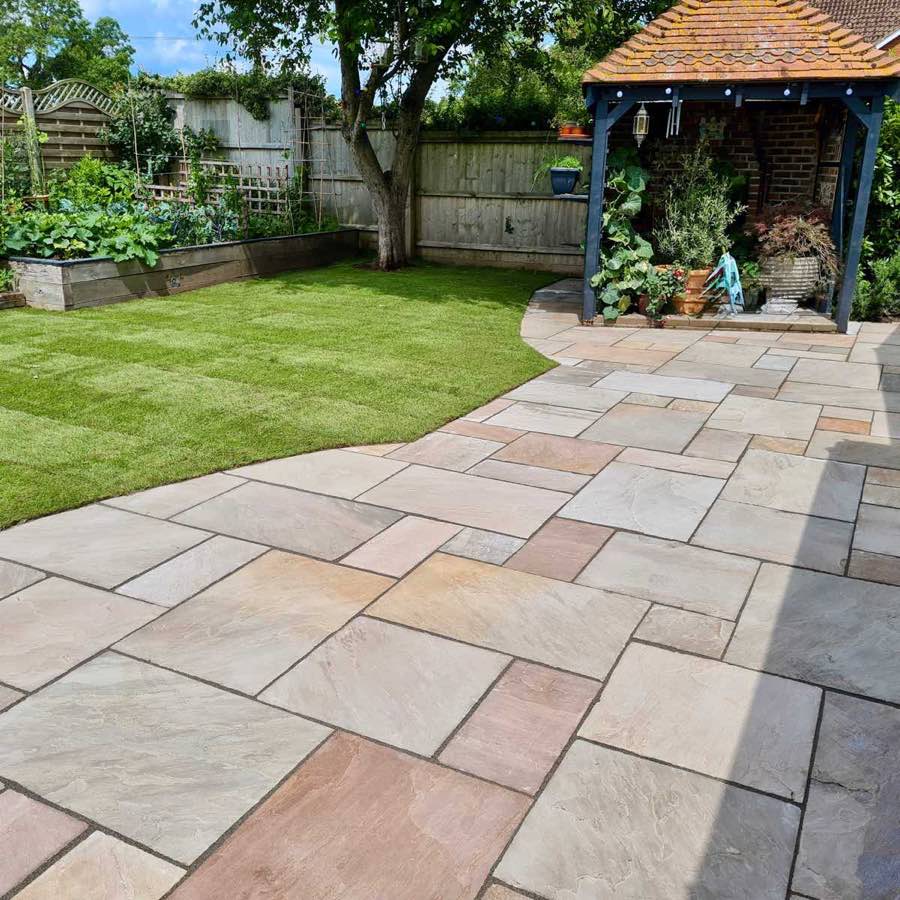
A patio laid on a proper base and correct falls is flat, quiet underfoot and drains away from the house — and it stays that way. Porcelain gives you a surface that looks identical in 10 years with almost no upkeep; Indian sandstone gives you warmth and a natural variation that suits older Cumbrian properties and weathers into the garden. We lay both, so the recommendation you get is about your house rather than about what we would rather install.
- Excavation and a compacted sub-base sized for a patio, not a footpath
- Full mortar bed under every slab — no dot-and-dab, ever
- Slurry primer on the back of every porcelain slab so it actually bonds
- Falls set away from the house and finishing below the damp course
- Drainage worked out before the first slab goes down, not after
- Cut edges finished square with a wet saw rather than chipped in
- Joints filled with a brush-in compound suited to the material
- Steps, copings and edgings matched to the main field
Choices
The patio options we offer
A few of the finishes we lay most. We bring samples to your free site visit so you can hold them against the house before you decide.
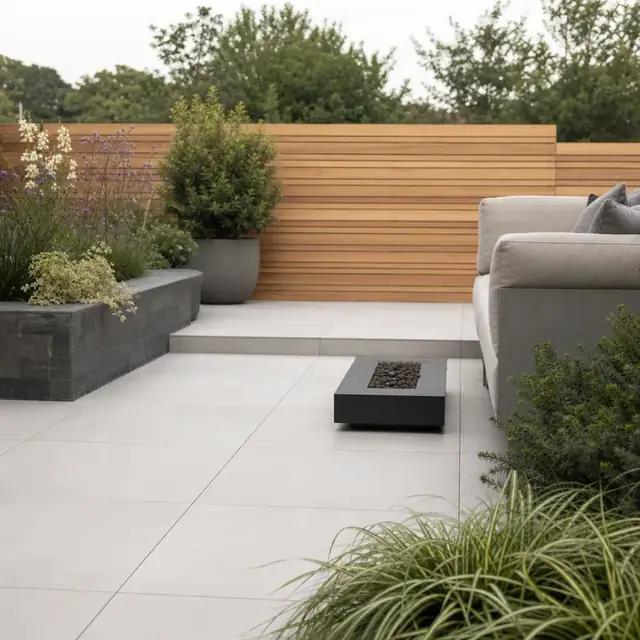
Porcelain
Fired to near-zero porosity, so it does not drink water. Red wine, barbecue fat and algae all wash off, it never needs sealing, and there is nothing inside it for frost to freeze and lift. The lowest-upkeep patio you can buy, and the one we recommend for a shaded, north-facing side. It costs more to lay than to buy: every slab needs a primed back and a full bed, and it is slower to cut.
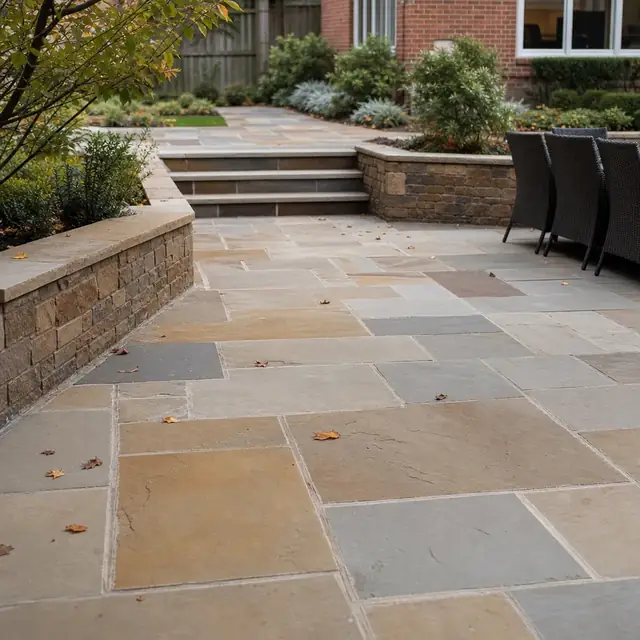
Indian sandstone
Riven rather than sawn, so every slab is slightly different — which is the whole point, and why it sits so naturally against Cumbrian stone and rendered houses. It is a natural material: it takes up water, it weathers, and it will tone with age. Warmer underfoot and warmer to look at than porcelain, and kinder on the budget for a large area.
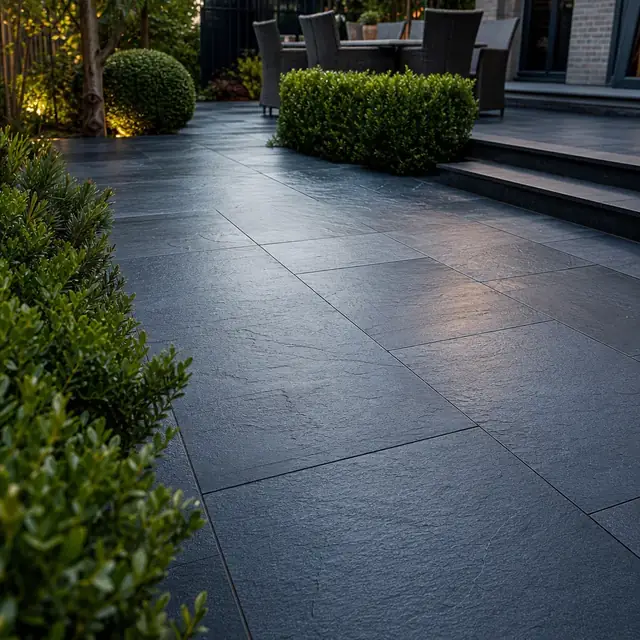
Natural stone and other options
Sawn sandstone for a cleaner, more uniform edge, limestone where you want a tighter grain, and slate on the right property. Less common up here and priced job by job, but we will quote any of them properly rather than steering you back to what is easiest to lay.
Porcelain or sandstone: how to actually decide
Start with the light. A north-facing patio in a wet climate spends most of the year damp and shaded, and natural stone goes green in those conditions — not because it is poor stone, but because algae takes hold in a porous surface that never fully dries. Porcelain has almost nothing for algae to grip. On a sunny south or west-facing garden, that advantage largely disappears and sandstone holds its own.
Then look at the house. Against Cumbrian stone, render or a red sandstone frontage, riven Indian sandstone reads as though it has always been there. A cool light-grey porcelain against an old stone cottage can look imported. The reverse is true of a modern extension with bifold doors, where sandstone can look fussy and porcelain looks intentional.
Then be honest about upkeep. Porcelain is wash-and-forget: soapy water when it looks tired, and no sealing ever. Sandstone wants a proper clean once a year and will tone and weather over time. Some people want a patio that stays exactly as laid; others want one that ages into the garden. Neither answer is wrong, but you should choose it rather than discover it.
Budget comes last, and it is closer than people expect. Porcelain slabs cost more than sandstone, but most of the price difference is labour rather than material: a primed back on every slab, a full bed, and slower cutting. Over a large area sandstone will usually come in lower. Over a small courtyard the gap is often not what decides it.
One thing that applies to both, and is worth more than the choice between them: a sealer will not rescue a bad base. If a patio is rocking, ponding or lifting, the answer is underneath the slabs and no product goes on top to fix it.
What a Cumbrian garden does to a patio
We get the rain and we get the freeze, and a patio here sees both in the same week. Water that has nowhere to go sits in the joints, gets into any void under a slab, freezes overnight and lifts it — which is why the falls and the bedding matter more here than they do in a drier county. Shade compounds it: a patio that never dries out grows algae, and on the wrong material that becomes an annual job. We design for the wet first and choose the stone second.
How It Works
Our patio process at a glance
You know the price in writing before anything gets dug up, and nothing is charged until you say go ahead.
-
01
Get in touch
Fill in the form or ring Taylor. Tell us where you are and roughly what you’re after.
-
02
We come and look
We visit, measure up and talk through the options. No obligation, and nothing to pay.
-
03
You get your quote
An itemised written price, fixed. Take as long as you need to think about it.
-
04
We book you in
We agree a start date and get the work done. 4 to 6 days on site for most driveways.
Living with it
Looking after your patio
Porcelain: wash it down with soapy water when it looks tired, and never seal it — a sealer cannot soak into a surface with almost no porosity, so it sits on top and goes patchy. Indian sandstone: a proper clean once a year, ideally before winter, and keep the joints topped up. Sealing sandstone is optional and we will give you a straight answer on what it does and does not achieve rather than selling it as standard. Both: sweep leaf litter off the joints, because rotting leaves are what feeds the green.
Our guarantee
5-year workmanship guarantee
Every driveway and patio we lay is guaranteed for 5 years against failure caused by our workmanship.
Get a Free QuoteWhere we work
Garden Patios & Paving across Cumbria
No call-out charge anywhere on this list, and nothing to pay for the quote.
FAQs
Common patio questions
Porcelain if the patio is shaded or north-facing, if the house is modern, or if you want a surface that looks the same in 10 years with almost no upkeep. Indian sandstone if the house is older Cumbrian stone or render, if you want warmth and natural variation, or if the area is large and budget matters. We lay both, so we will tell you which suits your garden rather than which suits us.
Outdoor porcelain is a different product from the tiles in a bathroom — it comes textured and slip-rated, and we lay R11-rated slabs outside as standard. It is no more slippery wet than natural stone, and considerably less so than smooth sealed concrete.
Almost always dot-and-dab: five blobs of mortar under each slab instead of a full bed. That leaves voids, water gets into them, freezes, and lifts the slab off. Natural stone and porcelain both need a full bed, and porcelain needs a slurry primer on the back as well. It is a slower job done properly, and we would rather price it that way than cut the bed.
Any patio in a wet, shaded spot will grow some algae — it is feeding on damp and leaf litter, not on the stone. Sandstone is more porous so it shows it sooner and needs a clean once a year. Porcelain has far less for it to grip. Keeping the joints swept and the falls working does more than any chemical.
For a back garden patio at ground level, almost never. It matters if you are raising the level significantly, building a raised terrace or platform, or working on a listed building or inside a conservation area — and a good part of the Lake District is one or the other. We will tell you at the site visit if it applies to yours.
Groundwork carries on through most of the winter. Mortar bedding needs the temperature to stay above roughly 5°C and needs frost kept off it while it cures, so a hard cold snap will pause the laying rather than the digging. We would rather lose a few days than bed slabs into mortar that will not cure properly.
Ready to transform your garden?
Free quotes, a 5-year workmanship guarantee, and a team that turns up when they say they will.